Category Archives: Uncategorized

Escape Velocity

Nearly three years after losing access to the sovereign bond market, Ireland appears to have built sufficient momentum to escape the troika’s orbit. Come early 2014, the country will no longer be subject to its quarterly visits and binding targets. The government will have succeeded in its number one political objective: ‘regaining our economic sovereignty’. But, what will really change?

When Ireland was first bailed out, I and many others thought it unlikely that the country could succeed in regaining market access by end-2013. In mid-2011, with interest rates on Irish government bonds soaring into double digits, such a benign scenario looked ever more remote.

Then, things changed. Increasingly, Ireland came to be seen as a special case, different from the struggling ‘Club Med’ countries. Irish bond yields fell dramatically, decoupling from those of Greece and Portugal. New ECB President Mario Draghi signalled that he was willing to do ‘whatever it takes’ save the Euro. Ben Bernanke, his American counterpart, kept the printing presses running, doubling down on his so-called ‘quantitative easing’ experiment. No doubt, this ‘easy money’ helped Ireland’s cause. High profile financiers made multi-billion euro bets on Ireland’s recovery story, and are already sitting on massive paper profits. The Irish banks also got in on the act, racking up significant holdings of Irish bonds rather than lending to businesses or households. Internally, economic pain may be manifest, but externally the mood music has been mostly positive. Continue reading
Ireland’s Investment Crisis: Diagnosis and Prescription

I have written in the past about Ireland’s deepening investment crisis. Last week’s CSO figures for Q1 2013 showed that investment had fallen 20% compared to the same quarter in 2012 while the investment rate had fallen to 9.7% of GDP. Here is a paper I wrote on the subject, recently published by the Nevin Economic Research Institute.

In short, a national investment bank focused on infrastructure and SME financing has never been more necessary.

Continue reading

Happy Holidays!

Wishing a merry Christmas and prosperous 2013 to all my readers !!

New Directions

Well, it’s been a busy month… between graduating from Columbia, visiting Ireland, holidaying in Spain, moving to Indonesia, and starting work with the World Bank.

That largely explains my lack of blog activity of late, something I hope to rectify in the coming days and weeks.

Meanwhile, I’m settling into life in Jakarta, a sprawling, bustling, booming metropolis that epitomizes ‘up by the bootstraps’ development in emerging Asia. The fourth most populated country in the world, Indonesia has been Asia’s sleeping giant, but partly driven by a commodities boom, it is rapidly rising to take its place beside China and India.

At the World Bank, I am working on two projects: one on the impact of FDI in the services sector on economic productivity, and the other on trade logistics, notably issues relating to Jakarta’s port facilities. At a time when much of the developed world is mired in economic stagnation, it is fascinating to be exposed to economic policy issues in a rapidly rising emerging nation.

A Great Little Documentary on Financial Instability

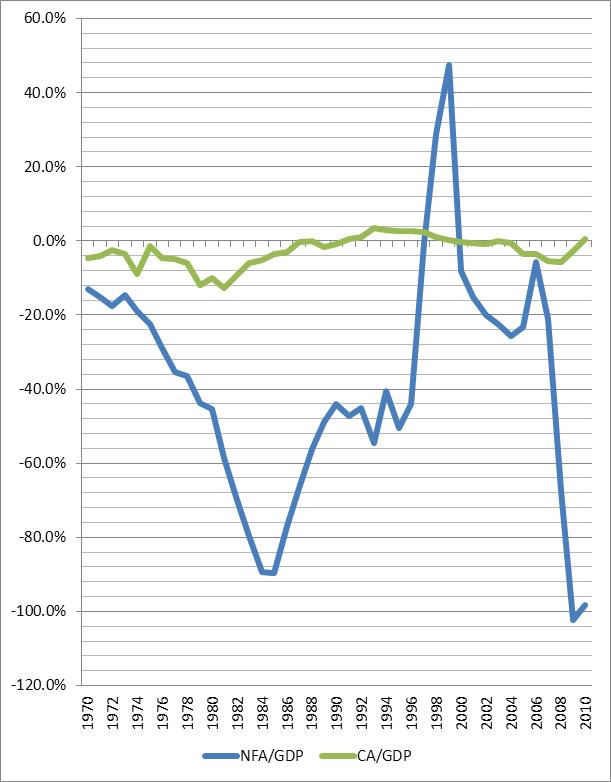
The Boom-Bust Life Cycle of Ireland’s Balance of Payments and Net Foreign Assets


Continue reading

2012: Global Recovery or False Dawn?

It’s not just the warm winter or early spring – the global economy really is looking brighter now than in the dark days of November.

US growth has been accelerating, unemployment falling, and Obama’s re-election chances improving. The EU appears to have gotten a handle on its debt crisis, for now, and a spiral from Recession to Depression has been averted. Continue reading

Circles Within Circles

This is a paper I wrote in December 2011 for a course in Global Economic Governance, taught be Kemal Dervis and José Antonio Ocampo.

At a global level, the G-20 has tasked the Financial Stability Board (FSB), successor to the Financial Stability Forum (FSF), with pursuing a macro-prudential mandate in close cooperation with the IMF. The EU established in early 2011 a European Systemic Risk Board (ESRB) to pursue a similar mandate at EU level, while the UK is creating a Financial Policy Committee (FPC), on a par with the Monetary Policy Committee, at the Bank of England.

In this paper, I compare and contrast their mandates, capacities, modus operandii, impact to date and perspectives for the future.

Dear Blogosphere…

To all of you who told me over the years that I’m so full of hot air I should be blogging… this is for you! I finally got around to it.

To take the bare look off it, I’ve posted some initial content – articles from my monthly column in SIPTU’s newspaper ‘Liberty‘.

For giving me the opportunity to write in my own voice, thank you to Jack O’Connor, Frank Connolly, and Scott Millar.

Watch this space.

Euro Treaty to Save Monetary Union?

Writing in this column two months ago, I suggested that Treaty change would be needed to save the Euro. Where once such talk was taboo, it is now clear that we are faced with such constitutional change, irrespective of the UK position. A real fiscal union would involve transfers to those regions for whom a one-size-fits-all monetary policy is inappropriate. What is in prospect is not a fiscal union, however, but an austerity club.

European leaders have finally realized the need for bold reform, but they’ve completely missed the point. The Eurozone crisis is less about members’ debts, and more about their competitiveness. Continue reading