Category Archives: emerging markets

The Coming Global Debt Crisis

The Irish, European and global economies have proved more resilient this year than many economists had feared. Yes, stubbornly high inflation has sapped consumers’ spending power. Yes, economic activity has slowed in the face of higher interest rates and lingering effects of the war in Ukraine. Yes, there was a wobble in the banking sector on both sides of the Atlantic, and we still don’t know how that will affect credit availability. But, there is little sign of the feared recession. Yet.

*** This article was first published at thejournal.ie on 1 May 2023 ***

Continue reading

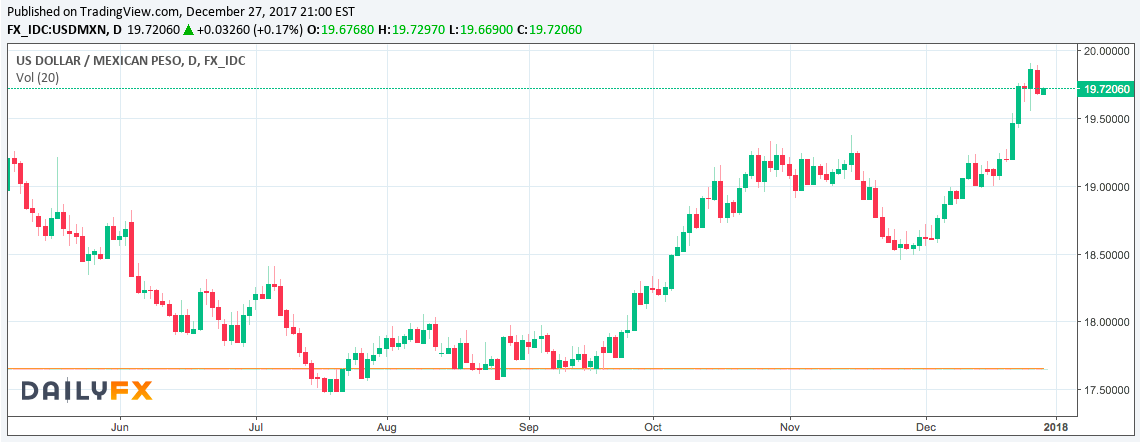
USD/MXN facing a perfect storm in H1 2018?

Overall, the Mexican peso has had a relatively good year in 2017, set to close a shade under 20 to the US dollar at end-December (19.72 at time of writing), having opened at the year at 20.74. This would make for a gain of about 5% for the year.

At the beginning of the year, the peso was still reeling from the election of Donald J. Trump as President of the U.S. on a platform hostile to imports of goods and people from Mexico. There was concern that he may follow through on threats to unilaterally withdraw from NAFTA, tax remittances and build a big border wall, among other measures. It was in the latter stages of a rout which would see the peso climb from a shade under 18 to the dollar in mid-August 2016 to an all-time high of nearly 22 in the third week of January 2017.

A strong nine-month run would see the peso more than retrace this move as the worst fears of a Trump Presidency appeared to have been unfounded, with the Mexican currency dipping back below 18 to the dollar during the summer months.

Continue reading

Mexico: political risk update

“May you live in interesting times” is a Chinese curse that seems apt to describe Mexico at its current political juncture. Times are certainly interesting. With the election of Donald Trump in the U.S., much focus in recent months has been outward-looking. Indeed, political risk in the diplomatic sphere is perhaps higher than at any time in living memory.

Domestically, the current administration is on the cusp of its final year in office, and the lame-duck status that goes with it. The pre-campaign to elect a new President in 2018 is well under way, with a very real possibility that Mexico will elect its first ever leftist President. At the same time, recent high-profile incarcerations of former high-level government officials and narco-traffickers has shone a spotlight on corruption and organised crime like never before.

With imminent – and important – state-level domestic elections in June 2017, seen by many as a prelude to the Presidential elections taking place in July 2018, the scope for political and policy change in Mexico over the period to late-2018 is significant. In light of the single term limit on the Mexican Presidency, the incumbent, Enrique Peña Nieto, will give way to his successor on December 1st, 2018. Opinion polls suggest a three-way fight between Peña Nieto’s PRI, the opposition PAN – which held the Presidency from 2000 to 2012 – and Andrés Manuel López Obrador (AMLO), at the head of Morena, the movement he left the PRD – traditionally Mexico’s 3rd party, and for whom AMLO twice contested the Presidency – to form.

Continue reading

Commodity Boom a Double-edged Sword for Africa

Powered by soaring commodity prices, Africa’s economic fortunes have been transformed since the turn of the century. This commodity boom was itself driven to a large extent by China’s resource-hungry investment-led growth model.

In 2012, China imported 17% of its fuels and 7% of its total mineral imports from Africa. Although commodity prices – from oil to precious metals and most things in between – remain elevated compared to late 20th century levels, what is often termed a decades-long ‘super cycle’ ran out of steam in the latter part of the 2000s. Commodity prices have since fallen, sometimes sharply, from their peaks.

Click here to read the full article.

East African Monetary Union – Proceed with Caution

While the economic woes of today’s Eurozone may give pause for thought on the pursuit of regional monetary union, African leaders remain steadfast in their aspirations for shared currencies.

Around the same time as the Maastricht Treaty laid the foundations for European Monetary Union, the 1991 Treaty of Abuja set in motion the continent’s initial integration program, the African Economic Community (AEC). The AEC was soon supplanted by the African Union in 2002 and ultimately aspires to establishing a continent-wide currency – the Afro – by 2028. The project aims to include a full suite of institutions: an African Monetary Fund, African Investment Bank and African Central Bank… Click here to read full article.

Service-sector reforms enhance manufacturing productivity: Evidence from Indonesia

Here’s a short piece on voxeu.org presenting research from a recent paper prepared by my co-authors and I.

Study: Liberalizing Foreign Investment in Services Boosts Manufacturing in Indonesia

Here is a post on the World Bank’s ‘The Trade Post’ blog written by Gonzalo Varela, Sjamsu Rahardja and myself on our recent working paper.

75 years, 107 days, and Mexico’s Reform Agenda

mexicoToday marks the 75th anniversary of the nationalization of Mexico’s oil industry, exactly one week after President Enrique Peña Nieto celebrated his first 100 days in power.

Mexican Presidents are elected for a single six year term, taking office in December. In modern times, regime change has been associated with economic and political upheaval.

Felipe Calderon’s razor thin victory in 2006 gave rise lengthy street protests and an aggressive militarization of government anti-drugs efforts driven, at least in part, by the newly-elected President’s attempt to assert his authority and establish legitimacy. Continue reading

Economic Premise: Service Sector Reform and Manufacturing Productivity

On foot of a recently published Policy Research Working Paper, exploring the potential for reforms to Indonesian service sector FDI policy to drive productivity in downstream manufacturing sectors, my co-authors and I have prepared a – much more digestible! – Economic Premise note for the World Bank’s Poverty Reduction and Economic Management Network. Published today, and available here.

Service Sector Reform and Manufacturing Productivity: Evidence from Indonesia

WorldBank_logoFor the past six months, I have been working with the World Bank in both Indonesia and in the US. In particular, I have been looking at the impact of changes to service sector FDI policies on productivity in downstream manufacturing sectors. Today, the fruits of these labours were published as a World Bank Policy Research Working Paper, co-authored with two of my colleagues from the Jakarta office. Continue reading