This blog is a year old this week.
In 2012, the three most popular posts (in terms of hits) were:
1) Financial Repression Update
2) The Boom Bust Life Cycle of Ireland’s Balance of Payments and Net Foreign Assets

This blog is a year old this week.
In 2012, the three most popular posts (in terms of hits) were:
1) Financial Repression Update
2) The Boom Bust Life Cycle of Ireland’s Balance of Payments and Net Foreign Assets
Posted in emerging markets, Ireland, Mexico, Political Risk
Wishing a merry Christmas and prosperous 2013 to all my readers !!
Posted in Uncategorized
The IMF yesterday published its 8th of 12 quarterly reviews of Ireland’s bailout program. This is what they had to say:
Posted in Ireland
This is my review of Gene Kerrigan’s latest book, “The Big Lie: Who Profits From Ireland’s Austerity?”, published in today’s Irish Times.
Posted in Articles for Irish Times, Book reviews, Ireland
We saw the first ripples of the US sub-prime crisis in the summer of 2007. A year later, the global economy was on the precipice of disaster. Only resolute action by world leaders, Gordon Brown not least among them, and coordinated fiscal and monetary stimulus prevented a re-run of the Great Depression.
Cracks in the Eurozone edifice which had been papered over during the good times were soon brutally exposed. As the crisis enters its seventh calendar year, we are more than half way through a lost decade. The question, particularly on Europe’s periphery is whether one lost decade will turn into two.
2013 promises to be yet another momentous year in Irish economic history; the year Ireland hopes to cease being a ward of the troika; a year plagued with potential banana skins. Without doubt, the fallout from yet another hair-shirt budget will dominate the early months of the year. It follows that we will face into a similarly challenging budget cycle as 2013 draws to a close. Like peeling an apple, the closer you get to the core, the more the pips squeak. Budgets will only get harder. Continue reading
Posted in Articles for SIPTU's Liberty, Euro, Global, Ireland
For all the doomsayers predicting an imminent ‘Grexit’ from the Eurozone, the latest EU deal to ease their debt burden to 124% of GDP by 2020 should surely give pause for thought… at least on timing, if not necessarily on the eventuality.
In observing the interminable crisis response efforts of Europe’s leaders, it is easy to confuse a lack of haste for a lack of resolve or a lack of understanding.
Certainly, the process may be frustratingly slow. This is particularly the case for financial markets with ADD and journalists with deadlines and a need for a simple narrative. Continue reading
Posted in Euro
Six months ago, I highlighted the increasing tendency of Irish banks, many of which are owned in whole or in part by the state, to hold on their books significant amounts of Irish government debt. Far from the ‘vicious circle’ between banks and sovereigns being broken, it is growing stronger than ever.
I noted then that in the 9 months to March 2012, Irish banks’ holdings of our national debt had increased by 40%, or more than EUR 4bn, during which time the benchmark yield on Ireland’s sovereign debt fell from 14% to 6%.
In the intervening 6 months, the banks’ holdings have increased by a further EUR 4.2bn (of which EUR 3.1bn is accounted for by the financial chicanery that saw Bank of Ireland effectively lend money to the government so that they didn’t have to borrow it elsewhere) to EUR 18.9bn, more than 10% of the total outstanding.
Irish Banks’ Holdings of Irish Sovereign Debt (EUR millions):
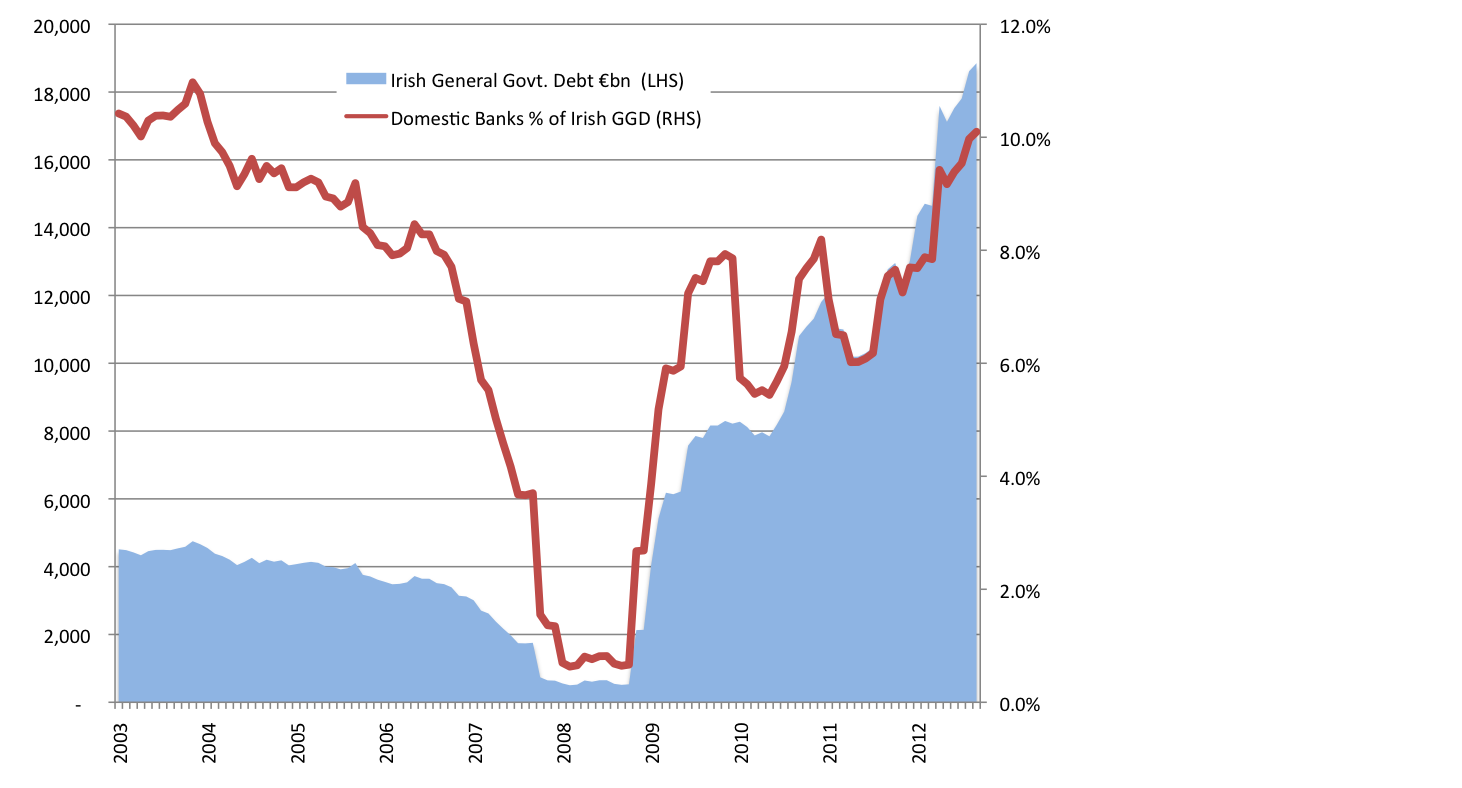 Source: Irish Central Bank Monthly Statistics, October 2012 and ntma.ie
When Europe’s leaders gathered in Brussels at the end of June, they decided to break the ‘vicious circle’ between bust banks and the countries that host them. Otherwise, the fear was that its banks could bring down Spain much as happened in Ireland.
Importantly, and in line with long-standing EU practice, it was agreed that favorable terms applied to Spain would be applied retrospectively to Ireland. Moreover, the Irish bailout was to be looked at with a view to ‘improving its sustainability’, recognizing implicitly that it was not on a sustainable path as things stood.
The agreement was hailed as a ‘game changer’ by some, a ‘seismic shift’ by others, and universally as at least a step in the right direction. Partly in expectation of a deal on its bank debt, Irish benchmark borrowing rates have fallen below 5% to levels not seen since before the 2010 bailout. Continue reading
Posted in Articles for SIPTU's Liberty, Euro, Ireland
While working with the World Bank over the summer, I contributed to this in-depth report on the state of Indonesia’s manufacturing sector, which has just been published.
Having never fully recovered its dynamism after the Asian financial crisis, now is the ideal moment for Indonesia’s manufacturing sector to recapture its former glory. With recent improvements and a favorable outlook, the sector may be on the verge of a renaissance if critical competitiveness challenges can be overcome. Continue reading
Posted in emerging markets, Indonesia
On the second working day of every month, the Department of Finance publishes the exchequer returns – a summary of the income, expenditure and deficit position of the country in the year to date. At the end or each quarter – so April, July, October and January – they publish the figures with the fanfare of a press conference. Yesterday, they published returns for the first nine months of this year.
So, what do the figures tell us?
Posted in Ireland
 vicduggan