Category Archives: Euro

Ireland’s Top 1%

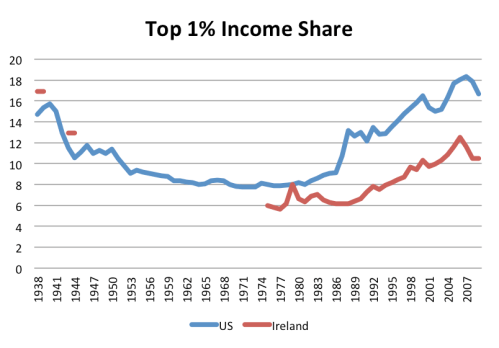
Nobel Laureate Joseph Stiglitz can stake some claim to being the intellectual father of the ‘Occupy’ movement with his May 2011 Vanity Fair article ‘Of the 1%, by the 1%, for the 1%‘. He followed up with a book in 2012, ‘The Price of Inequality‘. This, in turn, builds on inter alia the 2003 and 2004 scholarly works of Thomas Piketty and Emanuel Saez on income inequality in the US since 1913.
top1a

Piketty, Saez and others – including Ireland’s Brian Nolan – have since worked to bring together data on top income shares for some two dozen countries and counting in a consolidated database (complete with helpful interactive graphics).
Continue reading

’13: Another Year of Living Dangerously?

We saw the first ripples of the US sub-prime crisis in the summer of 2007. A year later, the global economy was on the precipice of disaster. Only resolute action by world leaders, Gordon Brown not least among them, and coordinated fiscal and monetary stimulus prevented a re-run of the Great Depression.

Cracks in the Eurozone edifice which had been papered over during the good times were soon brutally exposed. As the crisis enters its seventh calendar year, we are more than half way through a lost decade. The question, particularly on Europe’s periphery is whether one lost decade will turn into two.

2013 promises to be yet another momentous year in Irish economic history; the year Ireland hopes to cease being a ward of the troika; a year plagued with potential banana skins. Without doubt, the fallout from yet another hair-shirt budget will dominate the early months of the year. It follows that we will face into a similarly challenging budget cycle as 2013 draws to a close. Like peeling an apple, the closer you get to the core, the more the pips squeak. Budgets will only get harder. Continue reading

Keeping Greece on the Bus

For all the doomsayers predicting an imminent ‘Grexit’ from the Eurozone, the latest EU deal to ease their debt burden to 124% of GDP by 2020 should surely give pause for thought… at least on timing, if not necessarily on the eventuality.

In observing the interminable crisis response efforts of Europe’s leaders, it is easy to confuse a lack of haste for a lack of resolve or a lack of understanding.

Certainly, the process may be frustratingly slow. This is particularly the case for financial markets with ADD and journalists with deadlines and a need for a simple narrative. Continue reading

Whose Debt is it anyway??

When Europe’s leaders gathered in Brussels at the end of June, they decided to break the ‘vicious circle’ between bust banks and the countries that host them. Otherwise, the fear was that its banks could bring down Spain much as happened in Ireland.

Importantly, and in line with long-standing EU practice, it was agreed that favorable terms applied to Spain would be applied retrospectively to Ireland. Moreover, the Irish bailout was to be looked at with a view to ‘improving its sustainability’, recognizing implicitly that it was not on a sustainable path as things stood.

The agreement was hailed as a ‘game changer’ by some, a ‘seismic shift’ by others, and universally as at least a step in the right direction. Partly in expectation of a deal on its bank debt, Irish benchmark borrowing rates have fallen below 5% to levels not seen since before the 2010 bailout. Continue reading

Where to now for austerity?

As silly season gives way to budget season, Irish citizens and politicians alike are confronted with the depressing reality that not much has changed since they last checked: the economy is flatlined, unemployment remains stubbornly high, and the government is still borrowing more than a billion euro per month.

When Francois Hollande was elected President of France in May, a Gallic counterweight to German intransigence promised an alternative to austerity in Europe. Growth seemed to be very much on the agenda.

This spring-time optimism has given way to the cold, hard reality of Autumn. Measures to stimulate economic growth have been welcome, but in short supply. The Eurozone economy is mired in recession. Europe’s core and periphery alike will get little respite from the painful process of reducing budget deficits, even as economies shrink. More than ever, the growth agenda needs to be front and centre. Continue reading

Whatever it Takes

For going on two years,  the Eurozone policy response has seemed to be stuck in traffic. Mario Draghi’s mid-summer pledge to do ‘whatever it takes’ to save the euro raised expectations that a decisive moment was at hand. Last week, it looks like he delivered.

If Eurozone policymakers are no longer ‘stuck in traffic’, then one must wonder whether the junction at which they now find themselves is a crossroads or a roundabout. Is the Eurozone on the verge of turning a corner, or is this one more spin on the merry-go-round? Continue reading

Eurozone Policy Response in Suspended Animation

Europe’s policy response to the ongoing sovereign debt and banking crises on the continent’s periphery appears to be in suspended animation. There is a conflict between short-term expediency and long-term strategy, as was clear from the most recent European Council summit.

Spain, Italy and those debtor countries locked out of the bond markets are pushing for a speedy resolution that brings their financing costs down to sustainable levels. Among their desired outcomes are a mutualization of sovereign debt at a Eurozone level and / or unlimited ECB bond purchases on the secondary market.

The German-led creditor bloc is understandably reticent. It is they who feel they will foot the bill, after all. Their concern is ‘moral hazard’: if they give in to debtors’ demands, they fear all impetus for discipline and reform will be lost. One way of putting it might be that they are as yet unwilling to buy the first round of drinks, in case others fail to do their duty. Continue reading

Counterblast: Debunking the Baltic Myths

Here is a pamphlet I was commissioned to write for the Irish Congress of Trade Unions. It examines the recent economic experience of Latvia, Lithuania and Estonia, seeking to draw lessons for the Irish case.

The so-called Baltic Miracle has been held up as a shining example for Ireland and others to follow. Unable or unwilling to devalue their currencies when the financial crisis struck, the Baltics implemented the latest shock-therapy whizz: internal devaluation. Continue reading

Ireland’s Sudden Stop

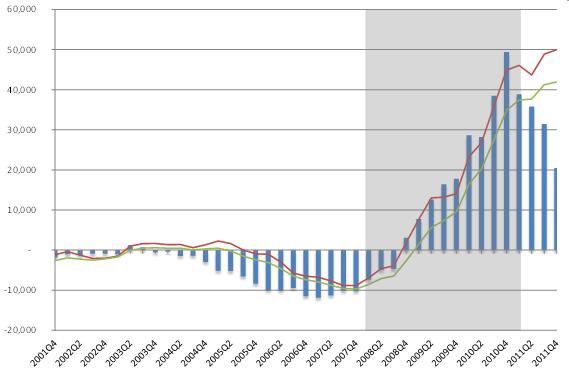
This graph is an extract from a term paper written by three co-authors and I for Professor Guillermo Calvo. We adapted Calvo’s own ‘Sudden Stop’ framework, and applied it to peripheral Europe.

Because the GIIPS are members of a monetary union, they experience some, but not all, of the effects typically associated with ‘Sudden Stops’. There is a large, if slower, adjustment in the Current Account as the capital needed to finance it dries up. Being members of monetary union, lacking monetary policy autonomy, inflation does not soar on the back of a currency devaluation, while the Real Exchange Rate adjustment – through ‘internal devaluation’ is consequently slower. Continue reading

Are Wages Adjusting on Europe’s Periphery?

Countries in economic crisis typically try to make their exports more competitive by devaluing their currencies. This option isn’t open to members of a monetary union (or those with a currency peg, like Latvia & Lithuania).

Hard-hit peripheral members of the Eurozone have been pursuing an ‘internal devaluation’ strategy, targeting an improvement in the all-important Real Exchange Rate by allowing nominal wages and prices to adjust. The graph below shows the extent to which labour costs have adjusted on Europe’s periphery since 2008, compared to Germany and the EU average.

Continue reading