Category Archives: Ireland

A Progressive Role for Public Pension Funds?

Perhaps the single best decision made by Charlie McCreevy as Minister for Finance was the establishment in 2001 of the National Pension Reserve Fund (NPRF). In addition to proceeds from privatizing Eircom, 1% of GNP was to be channeled annually into an investment fund dedicated to financing public service pensions from 2025 onwards.

Not only was the NPRF a sensible exercise in counter-cyclical fiscal policy, – in marked contrast to the habitual “If I have it, I spend it.” approach – it was a hefty down-payment on the otherwise unfunded public service pension liability.

Unfortunately, the best laid economic plans didn’t survive contact with Ireland’s world-beating banking crisis, the final bill for which will likely come in between a third and half of current national income. Continue reading
Dear Prudence, won’t you open up your eyes?

If one accepts the definition of insanity as doing the same thing over and over again, and expecting different results, then surely re-doubling belt-tightening austerity, and expecting growth, is economic lunacy?

The only part of the Irish economy that is growing in any meaningful sense is our record-breaking trade surplus. Overall, the economy can only grow if this is enough to offset the opposing contractionary forces of fiscal austerity and inconspicuous consumption. Continue reading

Ireland’s Sudden Stop

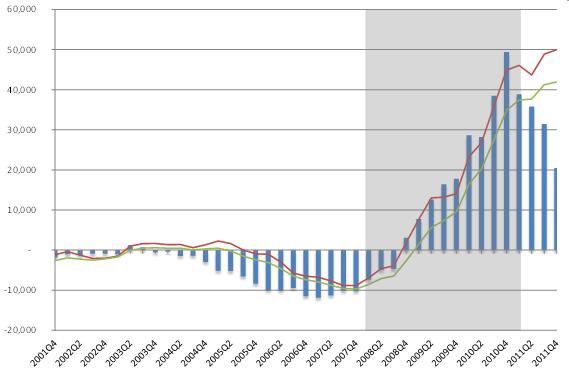
This graph is an extract from a term paper written by three co-authors and I for Professor Guillermo Calvo. We adapted Calvo’s own ‘Sudden Stop’ framework, and applied it to peripheral Europe.

Because the GIIPS are members of a monetary union, they experience some, but not all, of the effects typically associated with ‘Sudden Stops’. There is a large, if slower, adjustment in the Current Account as the capital needed to finance it dries up. Being members of monetary union, lacking monetary policy autonomy, inflation does not soar on the back of a currency devaluation, while the Real Exchange Rate adjustment – through ‘internal devaluation’ is consequently slower. Continue reading

Are Wages Adjusting on Europe’s Periphery?

Countries in economic crisis typically try to make their exports more competitive by devaluing their currencies. This option isn’t open to members of a monetary union (or those with a currency peg, like Latvia & Lithuania).

Hard-hit peripheral members of the Eurozone have been pursuing an ‘internal devaluation’ strategy, targeting an improvement in the all-important Real Exchange Rate by allowing nominal wages and prices to adjust. The graph below shows the extent to which labour costs have adjusted on Europe’s periphery since 2008, compared to Germany and the EU average.

Continue reading

This is What Financial Repression Looks Like

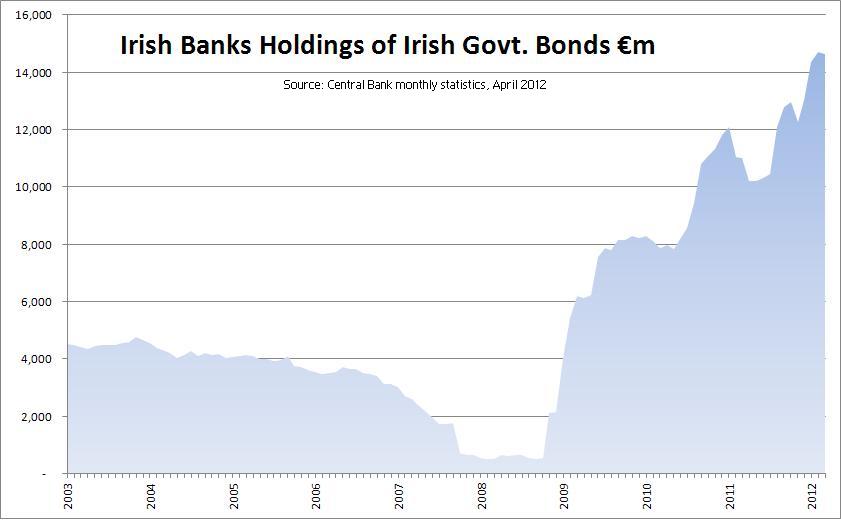
Since the blanket bank guarantee was introduced in September 2008, the Irish banks’ holdings of Irish sovereign debt have soared from a mere half billion euro to €14.6bn, or about 12% of total govt. debt.

In the 9 months since July 2011 alone, Irish banks’ holdings of our national debt have increased by 40%, or more than €4bn. Interestingly, the yield on benchmark 10 year Irish sovereign debt has fallen from over 14% then to just over 6% now. This is prima facie evidence of an increasing tendency towards financial repression in recent months.

Given that Irish resident holdings of our govt. debt has been trending downwards, one could conclude that the largely govt. owned banking sector has been snapping up govt. debt, just not not as quickly as the rest of the Irish private sector, including pension funds, has been offloading it.

Is there a false floor under Irish bond prices, and a consequent ceiling on yields?

On the Never Never

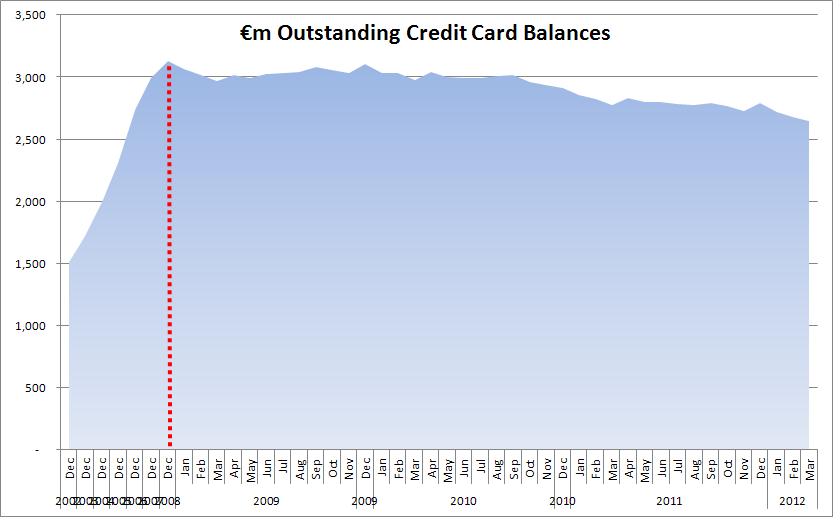
Since peaking at over €3.13bn in 2008, outstanding credit card balances in Ireland have fallen back 15.5% and now stand at €2.64bn. The average balance is  €1,251.

Source: Central Bank monthly statistics, April 2012

Rock Bottom?

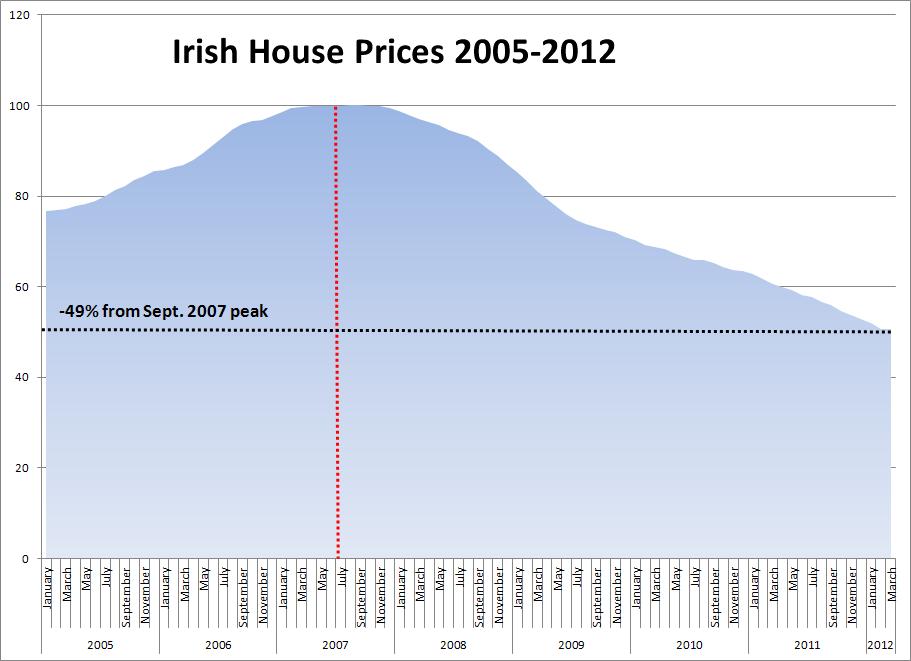
Much play has been made of the latest CSO data on property prices, which showed prices avoiding a fall in March for only the second month since  their peak in September 2007. Just as one swallow doesn’t make a summer, however, one month’s data doesn’t make a trend.


Overall, average house prices nationwide have fallen by49% since their peak according to the CSO, whose data is compiled on the basis of mortgage drawdowns. This likely understates the extent of the collapse in house prices, as it discounts cash transactions which have become increasingly important in recent years. Continue reading

“Where’s My Bailout?”

“It’s the economy stupid” was the maxim that propelled Bill Clinton to office in 1992. Clinton is a big believer in Ireland’s recovery story, but when he visited last year his chief caveat was on personal debt.

With what must have sounded like music to the ears of the many Irish people drowning in debt, he said that writing down personal debt more aggressively would speed recovery. Many activists and economists are in agreement on this, and the IMF recently weighed in with its support. Continue reading

Good PR, and a Cute Piece of Financial Engineering

These are my initial thoughts on the promissory notes ‘deal’ announced today by Minister Noonan.

  1. The cash-flow benefit is zero – we are just switching counterparties, from the EFSF etc. to Bank of Ireland (via NAMA).
  2. The impact on the (General Government) Deficit appears to be negative to the tune of EUR 90m. If this is the case, then this could mean an extra 90m in austerity measures this year to meet troika targets. Although there is a certain margin for manoeuvre built into the programme, between this 90m, lower-than-projected economic growth, and perhaps significant non-payment of the household charge, this margin may be wearing thin.
  3. This appears to be a great deal for the ECB (as ELA will effectively be repaid through LTRO via Bank of Ireland), for other EZ members (who will now be on the hook for 3.06bn less through the bailout – although this will ostensibly be used to help the NTMA build up a war-chest to smooth bond-market re-entry in 2013), and for Bank of Ireland (who keep the carry; borrowing at a low rate through the LTRO from the ECB, and lending to the govt. at a higher rate)… but an awful deal for Irish taxpayers.
  4. This would seem to be an explicit ECB endorsement of financial repression: Ireland’s only quasi-private sector bank of any significant size is being co-opted into financing govt., albeit being paid for the privilege.
  5. At a time when Irish banks are going through a rapid and painful deleveraging process, this deal will suck a further EUR 3.1bn out of their ‘real economy’ lending capacity. This will further tighten the screws on Irish firms and families struggling to get the credit they need.

As always, UCD Professor Karl Whelan is the go-to guy on all things promissory note related.

And Constantin Gurdgiev gives his thoughts here.

Europe’s Unholy Trinity

‘You Can’t Always Get What You Want’ sang the Rolling Stones in 1969. Jagger wasn’t singing about economic policy, but it’s a sentiment felt keenly by policy-makers the world over. They often face difficult choices between conflicting objectives.

Dani Rodrik, political economy professor at Harvard, has described an ‘inescapable trilemma’ at the heart of the world economy: we can have two of democracy, national sovereignty and open markets – but not all three fully and simultaneously.

As Europe’s elite desperately searches for a solution to stave off economic Armageddon, they face a similar trilemma. Technocrats’ assumption of power in Greece and Italy are cases in point. Continue reading