Can’t Pay, Won’t Pay

The debate on debt may go down as the defining debate of this decade. Everyone is painfully aware that after a borrowing-fuelled consumption and property bubble, Ireland is now reeling from the hangover.

The government is over-indebted, businesses are over-indebted, and families are over-indebted. Even the banks themselves are over-indebted, mandated by the troika to shrink their balance sheets, reining in credit for everyone else as a result. As a nation, we are among the world’s leaders in the borrowing race, total private sector credit standing at over 300% of GDP, even after IFSC activities are stripped out, and general government debt nearing 120% of GDP.

This debt overhang is undoubtedly undermining investment, job-creation and economic growth. Everyone is spending less, borrowing less, investing less and busy paying down loans to ‘repair their balance sheets’. Even though Ireland’s savings rate has increased markedly in recent years to about 11%, investment as a proportion of GDP is only 10%, near record lows and about half of where it needs to be at to retain and improve the country’s production capacity. Continue reading
Is Ireland Facing an Investment Crisis?

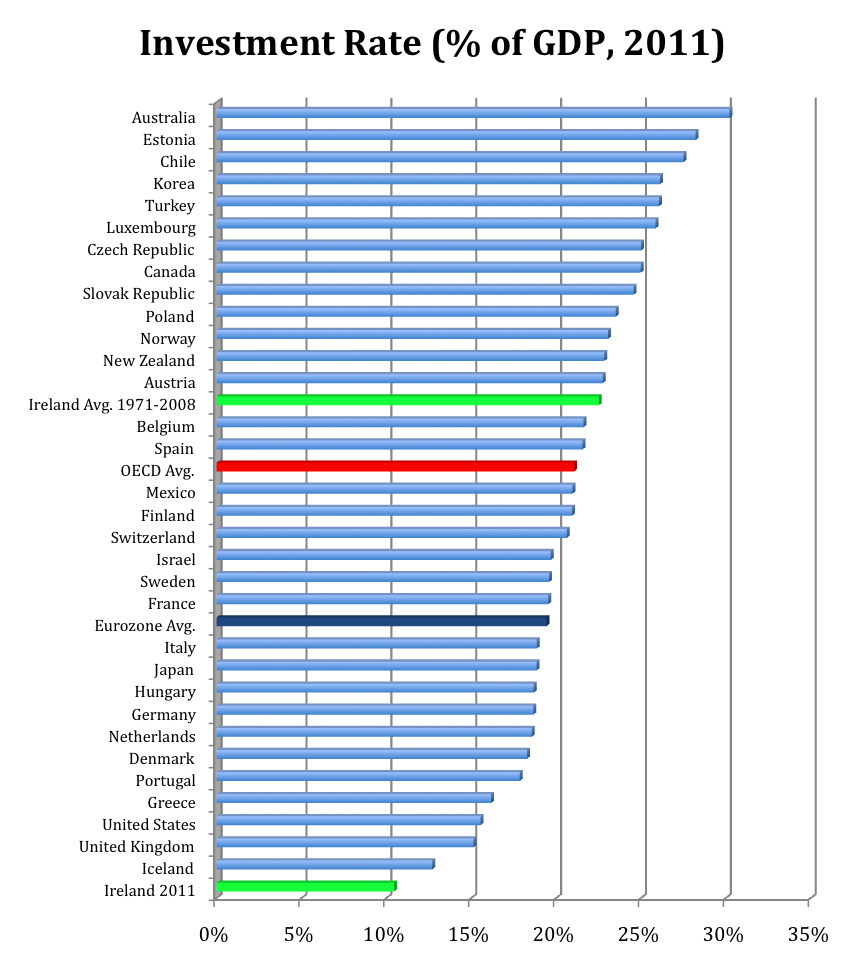
At 10%, the Irish investment rate (Gross Fixed Capital Formation / GDP) in 2011 was less than half the OECD average in 2011, half the Eurozone average, only four fifths that of Iceland, the next lowest OECD member at 12.7%, and less than Greece (16.2%), Portugal (17.9%), Italy (18.9%) and Spain (21.6%).

IREinvestment

Continue reading

Decomposing Irish GDP

No, this isn’t about painting the Irish economy as a rotting carcass.

It’s about breaking down Irish GDP into its different components, learning how to read the national accounts, looking at their long-term trends and how they changed when crisis struck from late 2007 onwards.

When economists agree that a certain formula must be true by definition, they call it an ‘identity’. A whole which is the sum of its parts is a good example, and one notable such example is the national income identity based on the sum of all expenditures in an economy in any given year:

Y = C + I + G + X – M

This simply means that Gross Domestic Product (GDP, or Y) is the sum of all personal consumption, investment, government expenditures on goods and services, plus exports, minus imports (ignoring, for the sake of simplicity, statistical discrepancies and changes in stocks or inventories, which are typically quite small in any event). Continue reading

Lower Income, Harder Living

The results of the latest Survey on Income and Living Conditions makes for interesting, if depressing, reading. The latest batch of data includes 2011 measures for income, inequality, poverty and deprivation as well as some significant revisions to the 2010 data.

2011 was the third successive year of falling disposable income, increasing poverty and deprivation.

  • Annual equivalised disposable income fell 3% year on year to €21,440 in 2011, down 12% from its 2008 peak of €24,380 and back at 2006 levels. When inflation is taken into account, despite a brief period of falling prices during 2009-2010, real disposable income is back at levels not seen since the early 2000’s. (equivalised simply means that when presenting household income, the data controls for the fact households are of varying size). Continue reading

Economic Premise: Service Sector Reform and Manufacturing Productivity

On foot of a recently published Policy Research Working Paper, exploring the potential for reforms to Indonesian service sector FDI policy to drive productivity in downstream manufacturing sectors, my co-authors and I have prepared a – much more digestible! – Economic Premise note for the World Bank’s Poverty Reduction and Economic Management Network. Published today, and available here.

Service Sector Reform and Manufacturing Productivity: Evidence from Indonesia

WorldBank_logoFor the past six months, I have been working with the World Bank in both Indonesia and in the US. In particular, I have been looking at the impact of changes to service sector FDI policies on productivity in downstream manufacturing sectors. Today, the fruits of these labours were published as a World Bank Policy Research Working Paper, co-authored with two of my colleagues from the Jakarta office. Continue reading

ESRI: By Any Measure, Ireland is Still a Low Tax Nation

Alongside its latest Quarterly Economic Commentary, the ESRI today published its usual series of interesting research notes on the Irish economy.

In light of Ireland’s ongoing fiscal consolidation efforts, and the accompanying public debate, two of the notes are of particular interest (even if one could draw opposite conclusions from them):

1) Tax and Taxable Capacity: Ireland in Comparative Perspective, by Tim Callan and Michael Savage.

2) The Macro-Economic Effects of Raising Revenue through Different Taxes, by  John Fitzgerald, Thomas Conefrey, Lara Malaguzzi Valeri and Richard Tol.

Callan and Savage take a look at the OECD’s 2011 Revenue Statistics to compare where Ireland stands in terms of taxation as a share of national income compared to our EU-15 neighbours.  Continue reading

Côte d’Ivoire: An Elephant at the Crossroads

cote_d_Ivoire_flagIn 2013, Côte d’Ivoire will be aiming to go one better than in 2012 across two fronts. The national football team will try to improve on last year’s runners-up spot in the African Cup of Nations, while the Ivorian authorities are targeting an increase in real GDP growth from 8.6% to 9%.

Having contracted by -4.7%  in 2011 on foot of the post-electoral political crisis that saw 3,000 people killed, real GDP rebounded strongly in 2012. Whether this represents a one-time recovery of lost ground or is indicative of higher trend growth remains to be seen. The Ivoirian authorities are aiming for double-digit growth rates from 2014 in a bid to position the country as an emerging market by 2020. Although slightly less bullish, the IMF expects a still impressive average growth rate of 7.5%  over the 2013-2015 period. Continue reading

The Psychology of Taxation

“Death, taxes and childbirth! There’s never a convenient time for them.” – Margaret Mitchell, Gone with the Wind, 1936

It is hardly controversial to suggest that rational people prefer to pay less tax rather than more, assuming all else is equal. If one follows the public debate in Ireland, however, it soon becomes clear that rationality is not universal on fiscal matters.

As the government struggles to bring the budget deficit under control, and as we are in a phase of increasing rather than stable or falling taxes, this is all the more pertinent. What is at issue, from the government’s perspective, is how to distribute and minimize citizens’ inevitable displeasure at rising taxes.

All taxes are not created equal, it would appear. What you pay tax on, and how you pay it, seems to matter a great deal,  perhaps even more so than the extent to which taxes hit our pockets. Continue reading

Ireland’s Top 1%

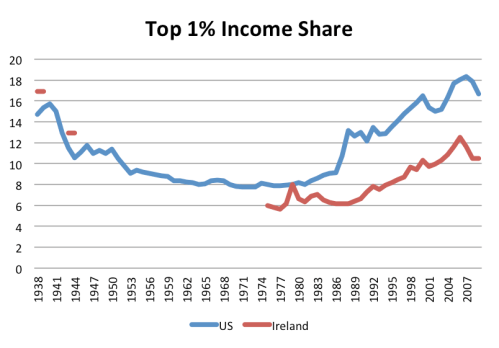
Nobel Laureate Joseph Stiglitz can stake some claim to being the intellectual father of the ‘Occupy’ movement with his May 2011 Vanity Fair article ‘Of the 1%, by the 1%, for the 1%‘. He followed up with a book in 2012, ‘The Price of Inequality‘. This, in turn, builds on inter alia the 2003 and 2004 scholarly works of Thomas Piketty and Emanuel Saez on income inequality in the US since 1913.

top1a

Piketty, Saez and others – including Ireland’s Brian Nolan – have since worked to bring together data on top income shares for some two dozen countries and counting in a consolidated database (complete with helpful interactive graphics).

Continue reading