Ireland’s Sudden Stop

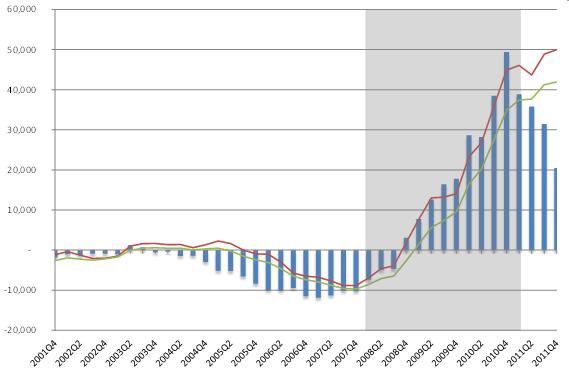
This graph is an extract from a term paper written by three co-authors and I for Professor Guillermo Calvo. We adapted Calvo’s own ‘Sudden Stop’ framework, and applied it to peripheral Europe.

Because the GIIPS are members of a monetary union, they experience some, but not all, of the effects typically associated with ‘Sudden Stops’. There is a large, if slower, adjustment in the Current Account as the capital needed to finance it dries up. Being members of monetary union, lacking monetary policy autonomy, inflation does not soar on the back of a currency devaluation, while the Real Exchange Rate adjustment – through ‘internal devaluation’ is consequently slower. Continue reading

Financial Liberalization & Financial Crises: No Smoke Without Fire

What role has financial liberalization, including capital account liberalization, played in recent financial crises in emerging markets? What policy conclusions should one draw from this?

You can’t have smoke without fire. Recent economic history would suggest that neither can you have financial crises without weak macroeconomic fundamentals. Certainly, capital flows can increase vulnerability to, and the amplitude of, emerging market crises. Moreover, it is often capital flow reversals that signal the onset of financial crises in dramatic fashion.

While it is true that prohibiting global capital flows would prevent or dampen many economic crises, it does not necessarily follow that this is the appropriate policy course. If you can’t have smoke without fire, then it’s also true to say that you can’t have fire without tinder. Removing all tinder would surely prevent future fires, but we should not forget that learning to use fire was one of homo sapiens’ most important social evolutions.

This this is not to say that all capital flows are good flows, or even that restrictions on flows could not yield a pareto improving outcome. It is simply recognition that a certain degree of international mobility of capital is critically important if emerging and developing economies are to have some chance of converging with advanced economies. Continue reading

Global Imbalances: It Takes Two to Tango

What role did global imbalances play in the center (2007-) financial crisis? What were the primary causes of theses imbalances? What are the difficulties involved in resolving them?

Just as it takes two to tango, so current account imbalances require offsetting capital flows to keep international payments in balance. Global imbalances thus have two drivers: borrowers and lenders. In the middle of the last decade, the US’ growing twin fiscal and current account deficits were the focus of much debate. Continue reading

Are Wages Adjusting on Europe’s Periphery?

Countries in economic crisis typically try to make their exports more competitive by devaluing their currencies. This option isn’t open to members of a monetary union (or those with a currency peg, like Latvia & Lithuania).

Hard-hit peripheral members of the Eurozone have been pursuing an ‘internal devaluation’ strategy, targeting an improvement in the all-important Real Exchange Rate by allowing nominal wages and prices to adjust. The graph below shows the extent to which labour costs have adjusted on Europe’s periphery since 2008, compared to Germany and the EU average.

Continue reading

This is What Financial Repression Looks Like

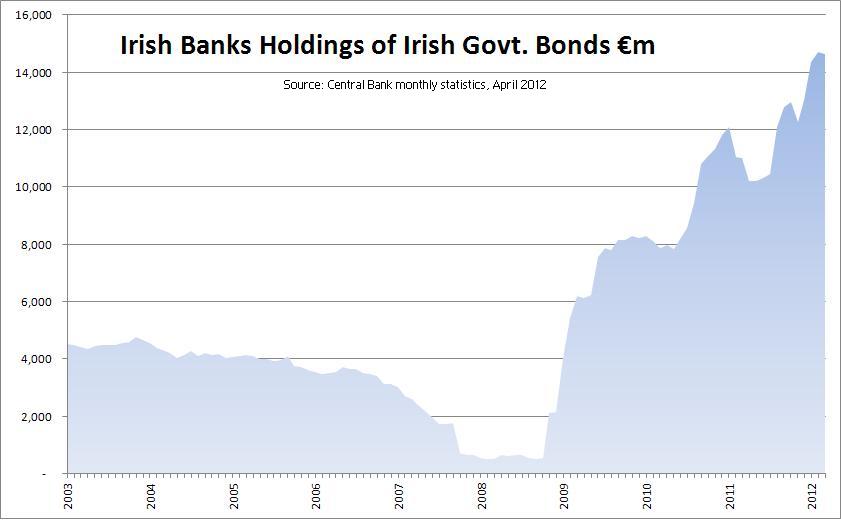
Since the blanket bank guarantee was introduced in September 2008, the Irish banks’ holdings of Irish sovereign debt have soared from a mere half billion euro to €14.6bn, or about 12% of total govt. debt.

In the 9 months since July 2011 alone, Irish banks’ holdings of our national debt have increased by 40%, or more than €4bn. Interestingly, the yield on benchmark 10 year Irish sovereign debt has fallen from over 14% then to just over 6% now. This is prima facie evidence of an increasing tendency towards financial repression in recent months.

Given that Irish resident holdings of our govt. debt has been trending downwards, one could conclude that the largely govt. owned banking sector has been snapping up govt. debt, just not not as quickly as the rest of the Irish private sector, including pension funds, has been offloading it.

Is there a false floor under Irish bond prices, and a consequent ceiling on yields?

On the Never Never

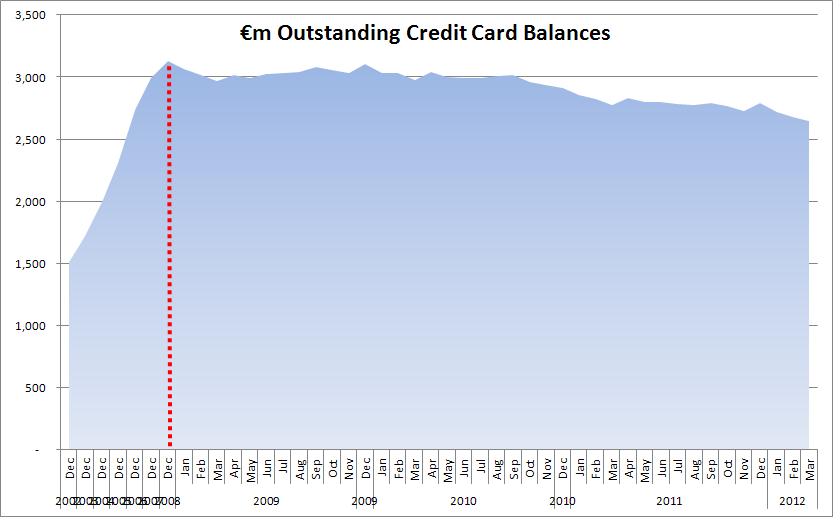
Since peaking at over €3.13bn in 2008, outstanding credit card balances in Ireland have fallen back 15.5% and now stand at €2.64bn. The average balance is  €1,251.

Source: Central Bank monthly statistics, April 2012

Rock Bottom?

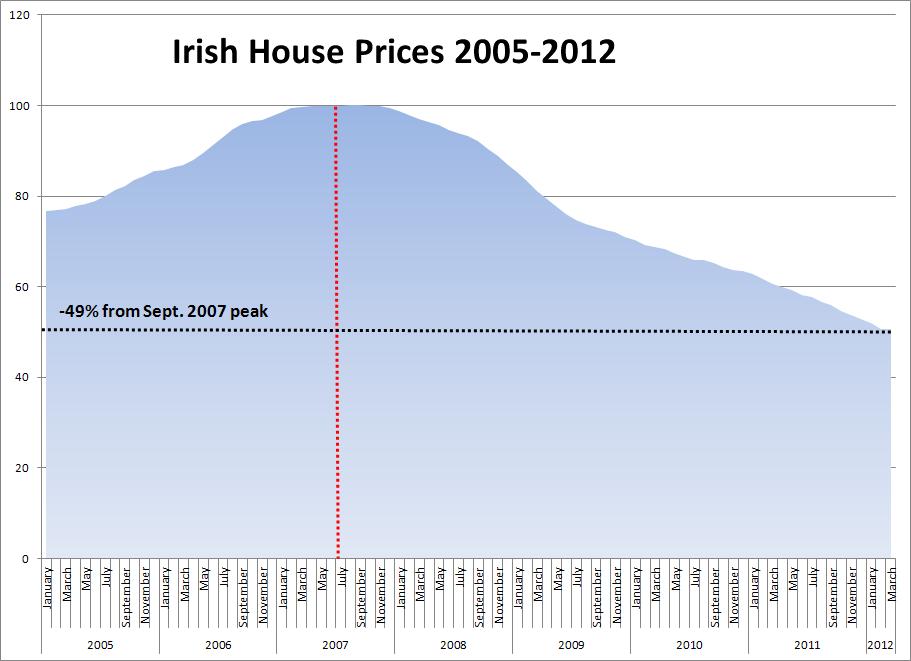
Much play has been made of the latest CSO data on property prices, which showed prices avoiding a fall in March for only the second month since  their peak in September 2007. Just as one swallow doesn’t make a summer, however, one month’s data doesn’t make a trend.


Overall, average house prices nationwide have fallen by49% since their peak according to the CSO, whose data is compiled on the basis of mortgage drawdowns. This likely understates the extent of the collapse in house prices, as it discounts cash transactions which have become increasingly important in recent years. Continue reading

Building Better Global Economic Governance

Today marks the launch of Columbia’s Center on Global Economic Governance (CGEG), with Alan Krueger, Chairman of President Obama’s Council of Economic Advisers delivering the keynote address at its opening conference.

The concept behind CGEG is to bring together the best minds, from Columbia faculty and from outside, to focus on key issues in global economic governance and develop effective policy approaches.

With developed economies largely stagnant, emerging markets facing their own challenges, and growing intra-national equality the world over, we need now more than ever a new approach to global economic governance that puts people first. The advent of the G20 as the premier forum for global governance widened the circle beyond the traditional G7/G8 configuration, but its initial impetus has dissipated, while issues of legitimacy remain to be addressed.

With Jeffrey Sachs and PEPM’s own Guillermo Calvo on the panel alongside Krueger and others on the panel, I’m really looking forward to the opening conference.

You can watch the livestream here from 9am EST / 2pm GMT.

You can find my own recent thoughts on the evolution of Global Economic Governance here.

Paradigm Lost

Last weekend, I had the great privilege of attending, as part of the Young Scholars’ Initiative, a sublime conference organized by the Institute of New Economic Thinking:

Paradigm Lost: Re-thinking Economics & Politics.

Leading lights of the economics profession came together with top policymakers and journalists to appraise the state of current economic thinking, and to chart a better way forward.

Conference highlights are viewable here. Continue reading

“Where’s My Bailout?”

“It’s the economy stupid” was the maxim that propelled Bill Clinton to office in 1992. Clinton is a big believer in Ireland’s recovery story, but when he visited last year his chief caveat was on personal debt.

With what must have sounded like music to the ears of the many Irish people drowning in debt, he said that writing down personal debt more aggressively would speed recovery. Many activists and economists are in agreement on this, and the IMF recently weighed in with its support. Continue reading